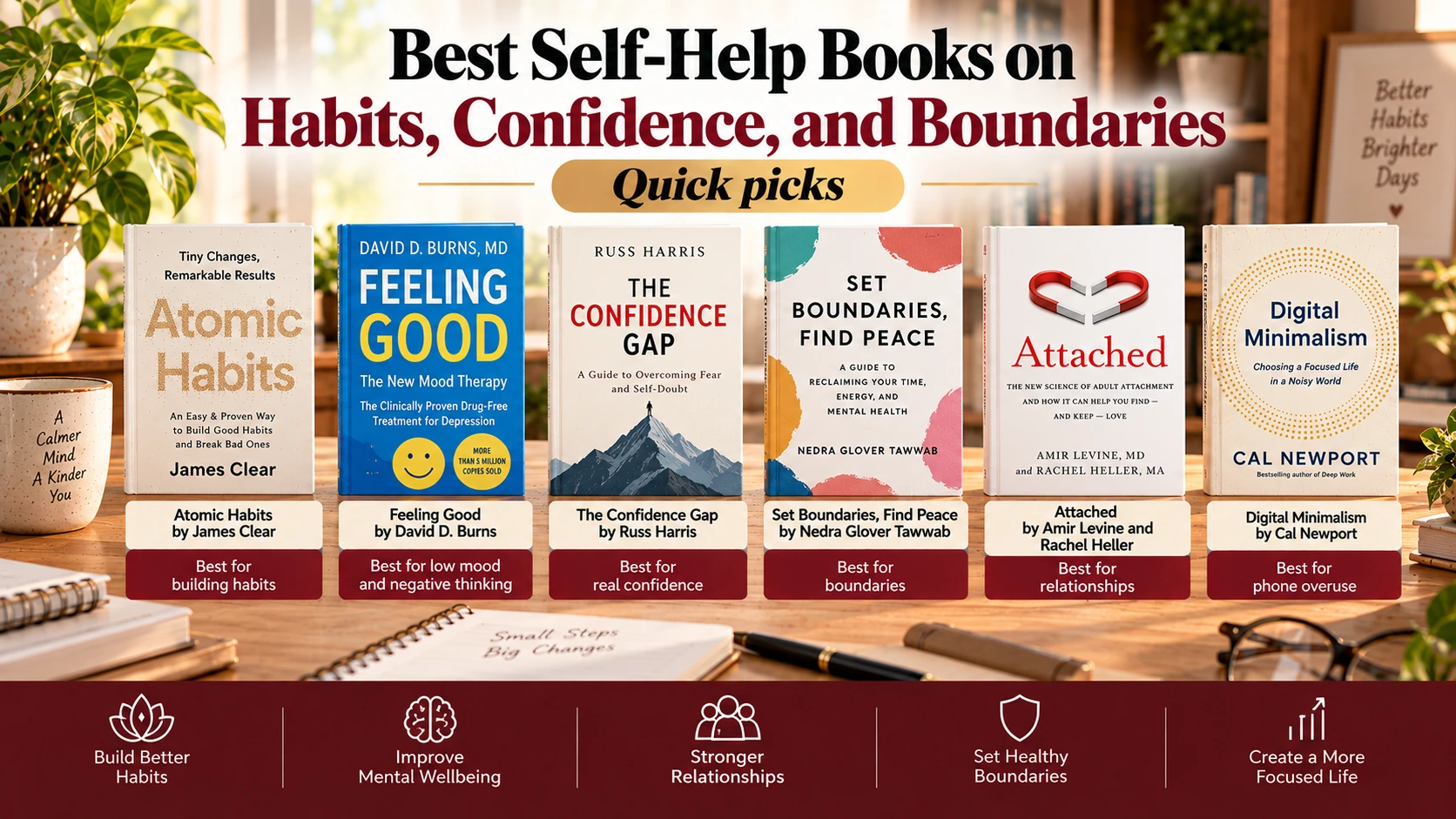
Quick picks
- Best for building habits: Atomic Habits by James Clear
- Best for low mood and negative thinking: Feeling Good by David D. Burns
- Best for real confidence: The Confidence Gap by Russ Harris
- Best for boundaries: Set Boundaries, Find Peace by Nedra Glover Tawwab
- Best for relationships: Attached by Amir Levine and Rachel Heller
- Best for phone overuse: Digital Minimalism by Cal Newport
Disclosure: As an Amazon Associate, I earn from qualifying purchases. This costs you nothing extra.
Why a curated list?
Search “self-help books” on Amazon and you’ll find thousands of titles, many promising to change your life in 30 days. Some are genuinely useful. Others are motivational fluff, or built on research that hasn’t held up.
This list focuses on books that teach practical skills you can use, grouped by the three goals our readers ask about most: building habits, growing real confidence, and handling relationships and boundaries. Where the research behind a book is strong, weak, or debated, we say so.
Do self-help books actually work?
Some do, and there’s real research on it. Using a book to work through a structured program is called bibliotherapy.
The strongest evidence is for depression. A 1997 meta-analysis by Pim Cuijpers found a large effect (0.82) for cognitive-behavioral self-help books compared with waiting-list controls in unipolar depression, and results comparable to individual therapy in the studies that compared the two. A 2004 meta-analysis of 17 studies found a similar large effect. (BC Medical Journal review) A 2017 systematic review in Clinical Psychology Review found that these benefits can last over the long term. (Gualano et al., 2017)
One book stands out. Much of this research used David Burns’s Feeling Good. In studies by Forrest Scogin and colleagues, adults with mild to moderate depression who worked through cognitive bibliotherapy improved, and a three-year follow-up found that their gains held. (Smith et al., 1997, Journal of Consulting and Clinical Psychology)
Not every popular idea holds up. For example, two 2018 meta-analyses in Psychological Science found that the link between a “growth mindset” and academic achievement was weak, and that mindset interventions had small average effects. (Sisk et al., 2018)
The takeaway: books built on established therapies, such as cognitive behavioral therapy (CBT) or acceptance and commitment therapy (ACT), and that ask you to practice skills, tend to be the most useful. Reading alone isn’t enough; doing the exercises is what helps.
Self-help books work best for mild to moderate difficulties. If you’re struggling with severe depression or anxiety, please reach out to a mental health professional.
How we chose, and how to spot a good self-help book
We picked books that:
- Teach specific skills or exercises, not just inspiration
- Draw on established psychology, such as CBT or ACT, or clearly explain their sources
- Are widely recommended by readers and practitioners over many years
- Match the topics our readers care about: habits, confidence, boundaries, and phone overuse
Signs of a useful self-help book:
- ☐ The author explains where their ideas come from
- ☐ It includes exercises, worksheets, or step-by-step practices
- ☐ It admits limits and suggests professional help when needed
- ☐ It doesn’t promise overnight transformation
Red flags: guaranteed results, “one secret” solutions, blaming you entirely for circumstances outside your control, or claims that sound too good to be true.
Best books on habits and productivity
1. Atomic Habits by James Clear
Best for: Anyone who wants to build good habits and break bad ones.
Clear’s book is built around four simple rules for changing behavior: make a habit obvious, attractive, easy, and satisfying (and reverse them to break a bad habit). Its focus on tiny, consistent improvements and on designing your environment makes it very practical.
Why we like it: clear, actionable, and easy to apply the same day.
Keep in mind: it’s a practical guide that draws on research, not an academic text.
2. Digital Minimalism by Cal Newport
Best for: Anyone who feels their phone or social media is taking over.
Newport argues for a deliberate approach to technology: decide what truly adds value, and step back from the rest. He proposes a 30-day “digital declutter” to reset your habits. It pairs well with our guide on how to reduce phone addiction.
Why we like it: a thoughtful, values-based plan rather than a list of tricks.
3. Four Thousand Weeks by Oliver Burkeman
Best for: People exhausted by productivity advice.
Named for the roughly 4,000 weeks in an average human life, this book takes a calmer, more honest look at time. Instead of promising to help you do everything, it helps you accept your limits and choose what matters.
Why we like it: a refreshing antidote to hustle culture.
Best books on confidence and self-worth
4. Feeling Good by David D. Burns
Best for: Low mood, harsh self-criticism, and negative thinking.
This classic teaches the core tools of cognitive behavioral therapy: spotting distorted thinking patterns and replacing them with more balanced thoughts. It’s one of the most studied self-help books, with research showing benefits for mild to moderate depression.
Why we like it: strong research support and practical exercises.
Keep in mind: it’s long, so work through it gradually rather than reading cover to cover.
5. The Confidence Gap by Russ Harris
Best for: People who wait to “feel confident” before acting.
Based on acceptance and commitment therapy (ACT), Harris argues that confident actions come first and confident feelings follow. He shows how to act on your values even when self-doubt shows up. It complements our article on building genuine confidence around people.
Why we like it: a realistic approach that doesn’t ask you to get rid of fear first.
6. Self-Compassion by Kristin Neff
Best for: Anyone who is much harder on themselves than on others.
Neff, a leading researcher on self-compassion, explains its three parts: self-kindness, recognizing our shared humanity, and mindfulness. The book includes practical exercises for treating yourself with the same care you’d offer a friend.
Why we like it: written by the researcher who helped define the field.
7. Mindset by Carol S. Dweck
Best for: Understanding how beliefs about ability shape effort.
Dweck’s idea of “fixed” versus “growth” mindsets is hugely influential and a useful lens for thinking about challenges and setbacks. An honest note: large reviews have found that the effects of growth mindset on academic achievement are smaller than the popular version suggests. Read it as a helpful perspective, not a magic fix.
Best books on boundaries, relationships, and emotions
8. Set Boundaries, Find Peace by Nedra Glover Tawwab
Best for: People-pleasers and anyone who struggles to say no.
Tawwab, a licensed therapist, explains different types of boundaries, why we avoid setting them, and how to communicate them clearly. The book includes scripts and reflection questions. Read it alongside our guide on how to set boundaries without feeling guilty.
Why we like it: practical scripts you can use in real conversations.
9. Attached by Amir Levine and Rachel Heller
Best for: Understanding patterns in your relationships.
This book introduces adult attachment theory, describing anxious, avoidant, and secure styles and how they play out between partners. Many readers find it helps explain why they pull close or push away. It connects naturally with our article Why do I push people away?
Keep in mind: attachment styles are a helpful framework, not fixed labels; people can and do change.
10. The Happiness Trap by Russ Harris
Best for: Anyone fighting anxious or painful thoughts.
Also based on ACT, this book teaches you to stop struggling against difficult thoughts and feelings and to focus instead on living by your values. It’s full of simple mindfulness exercises.
Why we like it: a clear introduction to ACT for everyday life.
11. Man’s Search for Meaning by Viktor E. Frankl
Best for: Finding purpose during hard times.
Frankl, a psychiatrist who survived Nazi concentration camps, reflects on how people can find meaning even in extreme suffering, and introduces the ideas behind his approach to therapy, logotherapy. It’s short but profound.
Why we like it: a timeless perspective that has helped readers for generations.
How to get more from a self-help book
- Read one book at a time. Finish and apply one before starting another.
- Do the exercises. The research on bibliotherapy is about working through a program, not just reading.
- Keep notes. Write down one idea per chapter you’ll try this week. A journal helps.
- Pick one change. Try it for two weeks before adding another.
- Revisit. Reread your notes after a month to see what stuck.
FAQs
Do self-help books really work?
Some do. Books based on cognitive behavioral therapy have good evidence for mild to moderate depression, especially when readers do the exercises.
Which self-help book should I read first?
Start with your biggest need: Atomic Habits for habits, Feeling Good for low mood, or Set Boundaries, Find Peace for people-pleasing.
Are audiobooks as good as print?
They’re great for absorbing ideas, but print or e-books make it easier to do exercises and take notes.
Can a self-help book replace therapy?
For mild difficulties, a good book can help a lot. For serious or ongoing problems, it’s best used alongside professional support, not instead of it.
Are these books available in India?
Yes. All are sold on Amazon.in, often in affordable Indian paperback editions, and most are available as Kindle e-books.
Final verdict
If you read only one book from this list, choose based on your goal: Atomic Habits to build better routines, Feeling Good for negative thinking and low mood, The Confidence Gap for self-doubt, or Set Boundaries, Find Peace if you struggle to say no. Then do the exercises, because that’s where the change happens.
Disclosure: As an Amazon Associate, I earn from qualifying purchases. Book details were checked in October 2026.
If you’re struggling with your mental health, please contact a mental health professional or a local helpline.
References
- Gualano MR, et al. (2017). The long-term effects of bibliotherapy in depression treatment: Systematic review of randomized clinical trials. Clinical Psychology Review, 58, 49–58. doi:10.1016/j.cpr.2017.09.006
- Smith NM, Floyd MR, Scogin F, Jamison CS. (1997). Three-year follow-up of bibliotherapy for depression. Journal of Consulting and Clinical Psychology, 65(2), 324–327. UT Southwestern research portal
- Sisk VF, Burgoyne AP, Sun J, Butler JL, Macnamara BN. (2018). To what extent and under which circumstances are growth mind-sets important to academic achievement? Two meta-analyses. Psychological Science, 29(4), 549–571. doi:10.1177/0956797617739704
- BC Medical Journal. (2024). Bibliotherapy: the review, organization, and dissemination of recommended reading for psychiatry patients. bcmj.org