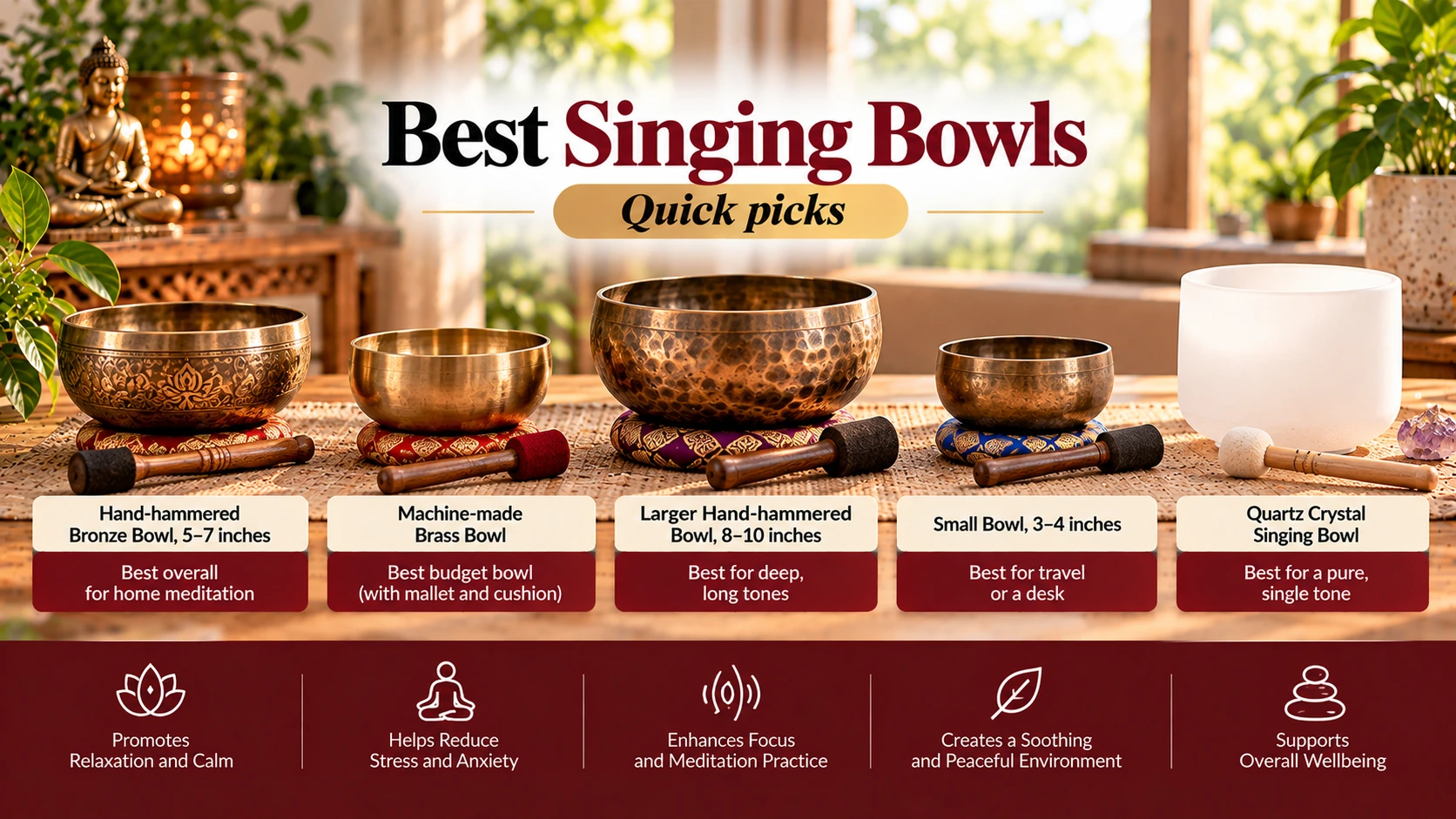
Quick picks
- Best overall for home meditation: A hand-hammered bronze bowl, 5–7 inches
- Best budget bowl: A machine-made brass bowl with a mallet and cushion
- Best for deep, long tones: A larger hand-hammered bowl, 8–10 inches
- Best for travel or a desk: A small bowl, 3–4 inches
- Best for a pure, single tone: A quartz crystal singing bowl
Disclosure: As an Amazon Associate, I earn from qualifying purchases. This costs you nothing extra.
Why a singing bowl?
Strike a singing bowl and the sound slowly fades over many seconds. Following that fading tone is a simple way to settle your attention at the start of meditation, and many people find the sound deeply calming.
But buying one online is confusing. Listings promise “antique,” “hand-hammered,” “seven-metal” bowls with healing powers, often at prices that make those claims unlikely. This guide helps you understand what you’re actually buying, what the research says, and which type of bowl suits you.
How we chose: These recommendations are based on guidance from singing bowl makers and sellers about construction and sound, and on published research on singing bowl meditation. We have not tested individual bowls.
Comparison table
| Bowl type | Material | Sound | Size | Fake risk | Price tier |
| Hand-hammered (medium) | Bronze (copper and tin) | Rich, layered overtones, long sustain | 5–7 in | High | Mid |
| Machine-made | Usually brass | Clear, simpler tone, shorter sustain | Varies | Low (if sold honestly) | Budget |
| Hand-hammered (large) | Bronze | Deep, long-lasting tone | 8–10 in | High | Premium |
| Small travel bowl | Bronze or brass | Higher, brighter tone | 3–4 in | Medium | Budget |
| Crystal bowl | Quartz | Pure, single tone, very loud | Varies | Medium | Mid to premium |
Price guide: genuine hand-hammered bowls typically cost noticeably more than machine-made ones. Singing bowl sellers note that bowls under about $100 are mostly machine-made, even if they look hammered. Check live prices before buying.
What research says about singing bowl meditation
One encouraging study, with big limits. In a 2017 observational study, 62 adults took part in a singing bowl sound meditation. Afterward, they reported significantly less tension, anger, fatigue, and depressed mood, and greater spiritual well-being. People new to this type of meditation saw the biggest drop in tension. (Goldsby et al., 2017) But there was no control group, so we can’t tell how much came from the bowls versus simply relaxing in a calm setting.
The reviews are cautious. A 2020 systematic review in Complementary Therapies in Medicine found only four peer-reviewed studies on the health effects of singing bowls. Given so few studies and the risk of bias, the authors said they could not recommend singing bowl therapies, though results pointed in a positive direction. (Stanhope & Weinstein, 2020) A 2025 review of more studies concluded that singing bowls may have potential for anxiety, depression, and sleep, but the evidence base is still small. (Cai et al., 2025)
The honest takeaway: a singing bowl is best seen as a tool for meditation: a sound to focus on and a way to mark the start and end of your practice. It isn’t a proven treatment for any health condition. Be wary of listings that promise healing, chakra balancing, or cures.
If you’re building a meditation habit, our meditation guides are a good companion.
How to choose a singing bowl
Hand-hammered vs machine-made
- Hand-hammered bowls are shaped from bronze by artisans striking the hot metal. They show irregular, overlapping hammer marks of different sizes, and their uneven walls produce rich, layered overtones that ring for a long time.
- Machine-made bowls are cast or spun, usually from brass. They’re either smooth or show neat, uniform circular lines. Their sound is clearer and simpler and fades faster, but they’re perfectly pleasant to use.
- Watch for fake “hammering.” Some machine-made bowls are covered in perfectly round, evenly spaced dimples to look hand-forged. Real hammer marks are irregular. (Bodhisattva Trading)
The “seven metals” myth
Many listings claim bowls are made from seven sacred metals. Singing bowl specialists note that early bowls were mainly bronze (copper and tin), and when other metals are added, they’re usually present in tiny amounts. A two-metal bronze bowl is not a fake. Treat “seven metals” as a marketing claim, not a quality guarantee. (Instruments du Monde)
Size and tone
Smaller bowls (3–5 inches) have higher, brighter tones. Larger bowls (8 inches and up) have deeper tones that last longer. A 5–7 inch bowl is a good all-round size for home meditation.
Listing checklist
- ☐ Material stated clearly (bronze or brass)
- ☐ Method stated honestly (hand-hammered or machine-made)
- ☐ Diameter and weight listed
- ☐ Includes a mallet (ideally leather- or suede-wrapped) and a cushion
- ☐ A video or audio clip of the bowl’s sound in the listing or reviews
- ☐ No promises to cure or heal health conditions
- ☐ A clear return policy
The 5 best singing bowls to buy
1. Hand-hammered bronze bowl, 5–7 inches: Best overall for home meditation
Best for: Daily home meditation and anyone who wants a rich, long-ringing tone.
A medium hand-hammered bowl is the classic choice. It’s large enough for a full, layered sound but small enough to hold in your palm while you play it. Many are made in Nepal.
What to look for: bronze, irregular hammer marks, a sound sample, and a mallet and cushion included.
What we like
- Rich, complex sound with a long fade
- Each bowl has its own character
What could be better
- Costs more than machine-made bowls
- “Hand-hammered” claims are often inaccurate
2. Machine-made brass bowl set: Best budget bowl
Best for: Beginners, gifting, or trying a bowl before investing more.
An honest machine-made bowl gives a clear, pleasant tone at a low price. Sets usually include a mallet and a cushion, which is all you need to start.
What to look for: a listing that honestly says machine-made, a weight that feels substantial, and a sound sample.
What we like
- Affordable and consistent
- Good for learning to play
What could be better
- Simpler tone that fades faster
- Often sold with exaggerated claims
3. Large hand-hammered bowl, 8–10 inches: Best for deep, long tones
Best for: Longer meditations, group sessions, or a deeper, grounding sound.
Larger bowls produce lower tones that ring for much longer. They’re best placed on a cushion rather than held.
What to look for: bronze, a sound sample, a large cushion or ring stand, and a padded mallet.
What we like
- Deep, resonant tone
- Very long sustain
What could be better
- Heavy and expensive
- Takes up more space
4. Small 3–4 inch bowl: Best for travel or a desk
Best for: A quick mindful pause at work, travel, or a small altar.
Small bowls are bright, portable, and inexpensive. They’re useful as a “bell” to start and end a short meditation.
What we like
- Portable and affordable
- Easy to play
What could be better
- Higher, thinner tone
- Shorter ring
5. Quartz crystal singing bowl: Best for a pure, single tone
Best for: People who prefer a clean, steady note.
Crystal bowls are made from quartz and produce a pure, very loud tone that’s quite different from the layered sound of metal bowls. They’re also an option for anyone sensitive to metals.
What we like
- Clear, powerful tone
- No metal contact
What could be better
- Fragile; can break if dropped
- Very loud in small rooms
For readers in India: many bowls made in Nepal are available on Amazon.in. Use the checklist above, and listen to sound samples in reviews before buying.
How to play a singing bowl
Striking (the easiest way to start):
- Rest the bowl on its cushion or on your flat palm. Don’t grip the sides, which dampens the sound.
- Hold the mallet like a pencil, near the top.
- Strike the outer rim gently with the padded side.
- Listen to the tone until it fades completely. This is a natural focus point for meditation.
Rimming (making the bowl “sing”):
- Strike the bowl gently once to start the vibration.
- Press the wooden side of the mallet against the outer rim at a slight angle.
- Move it slowly and steadily around the rim with even pressure, keeping your arm moving rather than just your wrist.
- The sound will build into a continuous hum. If it rattles, slow down and press a little more firmly.
Using it in meditation: strike the bowl once to begin, follow the sound until it disappears, and let that be the start of your sitting. Strike it again to close.
Safety: don’t hold a bowl right next to someone’s ear while it’s ringing, and keep the volume comfortable, especially with large or crystal bowls.
FAQs
What size singing bowl is best for beginners?
A 5–7 inch bowl is a good all-round size: easy to hold and play, with a full tone.
How can I tell if a singing bowl is hand-hammered?
Look for irregular, overlapping hammer marks of different sizes and depths. Perfectly smooth surfaces, uniform circular lines, or neat, evenly spaced dimples suggest a machine-made bowl.
Do singing bowls need to be made of seven metals?
No. Traditional bowls were mainly bronze. “Seven metals” is mostly a marketing claim.
Do singing bowls have proven health benefits?
Not yet. A few small studies suggest they may help people feel calmer, but reviews say the evidence is too limited to recommend them as therapy.
Metal or crystal: which is better?
It depends on taste. Metal bowls have rich, layered tones; crystal bowls have a pure, steady note and are louder and more fragile.
How do I clean a singing bowl?
Wipe it with a soft, dry cloth. Avoid harsh chemicals and soaking, and follow any care advice from the seller.
Final verdict
For most people, a 5–7 inch hand-hammered bronze bowl is the best singing bowl for home meditation: rich, long-ringing, and easy to play. If you’re just curious, an honestly labeled machine-made brass set is a low-cost way to start. Choose a larger bowl for deeper tones, or a crystal bowl for a pure, steady note.
Whatever you buy, judge it by its sound, not by claims of healing or “seven sacred metals.”
Disclosure: As an Amazon Associate, I earn from qualifying purchases. Information checked in October 2026.
Singing bowls can support relaxation but are not a treatment for any health condition.
References
- Goldsby TL, Goldsby ME, McWalters M, Mills PJ. (2017). Effects of singing bowl sound meditation on mood, tension, and well-being: An observational study. Journal of Evidence-Based Complementary & Alternative Medicine, 22(3), 401–406. doi:10.1177/2156587216668109
- Stanhope J, Weinstein P. (2020). The human health effects of singing bowls: A systematic review. Complementary Therapies in Medicine, 51, 102412. doi:10.1016/j.ctim.2020.102412
- Cai Y, et al. (2025). Therapeutic effects of singing bowls: A systematic review of clinical studies. Integrative Medicine Research, 14(2), 101144. doi:10.1016/j.imr.2025.101144
- Instruments du Monde. How to recognize a genuine Tibetan singing bowl. instruments-du-monde.com
- Bodhisattva Trading. Choosing a singing bowl. bodhisattva.com