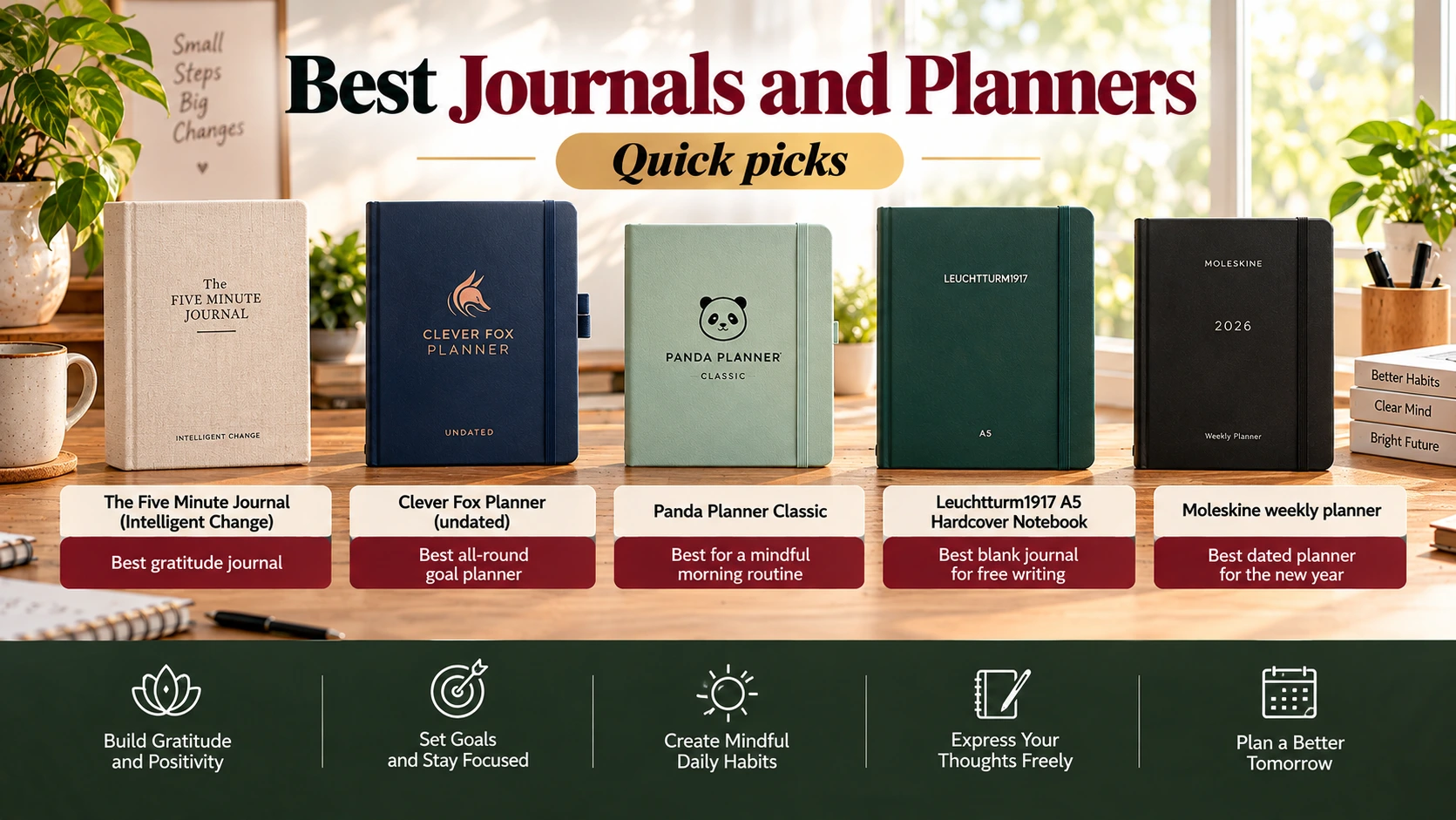
Quick picks
- Best gratitude journal: The Five Minute Journal (Intelligent Change)
- Best all-round goal planner: Clever Fox Planner (undated)
- Best for a mindful morning routine: Panda Planner Classic
- Best blank journal for free writing: Leuchtturm1917 A5 Hardcover Notebook
- Best dated planner for the new year: Moleskine weekly planner
Disclosure: As an Amazon Associate, I earn from qualifying purchases. This costs you nothing extra.
Why put pen to paper?
Your mind is a poor storage system. Unfinished tasks, worries, and half-formed ideas keep circling, especially at night. Writing them down gets them out of your head and onto a page where you can actually deal with them.
The right journal or planner depends on what you want from it: more gratitude, clearer goals, calmer evenings, or simply a place to think. This guide explains what research says about each type of writing and which journals and planners suit each goal.
How we chose: We have not tested these products ourselves. Our picks are based on product layouts, independent reviews, and patterns in verified buyer feedback. We favored undated options you can start anytime, durable paper, and layouts backed by research-supported practices.
Comparison table
| Product | Type | Best for | Dated? | Daily time | Price tier |
| The Five Minute Journal | Guided gratitude journal | Building a gratitude habit | Undated | About 5 minutes | Mid |
| Clever Fox Planner | Goal and weekly planner | Goals, habits, weekly planning | Undated (dated editions also sold) | 5–15 minutes | Budget to mid |
| Panda Planner Classic | Daily planner with mindset prompts | Focus, gratitude, and daily tasks | Undated | 5–10 minutes | Budget to mid |
| Leuchtturm1917 A5 | Blank, lined, or dotted notebook | Free writing, bullet journaling | Not applicable | Any | Mid |
| Moleskine weekly planner | Dated weekly planner | Appointments and simple planning | Dated | A few minutes | Mid |
Price tiers: Budget = usually under $20 (₹1,000); Mid = $20–$35 (₹1,000–₹3,000). Check live prices on Amazon.
What research says about journaling and planning
Different kinds of writing do different things. Here’s what the evidence shows for the three most common.
Gratitude journaling. In a classic set of experiments published in the Journal of Personality and Social Psychology in 2003, Robert Emmons and Michael McCullough asked people to list things they were grateful for, either weekly or daily. Compared with people who listed hassles or neutral events, the gratitude groups showed higher well-being on several, though not all, measures; the boost in positive mood was the most consistent finding. Berkeley’s Greater Good Science Center summarizes the findings as more gratitude, more positive moods, more optimism, and better sleep. (Emmons & McCullough, 2003; Greater Good in Action)
Writing a to-do list before bed. In a 2018 sleep-lab study at Baylor University, 57 young adults spent five minutes before bed writing either a to-do list for the coming days or a list of tasks they’d already completed. Their sleep was measured with polysomnography, the gold standard. The to-do list group fell asleep about 9 minutes faster on average, and the more specific their lists, the faster they fell asleep. One caveat: the study had no “no-writing” group, and all participants were healthy young adults. (Baylor University; Scullin et al., 2018)
Expressive writing. Writing about your deepest thoughts and feelings has been studied for decades. A large 2006 meta-analysis of 146 randomized studies in Psychological Bulletin found a positive but small average effect on health and well-being. (Frattaroli, 2006) In other words, it helps many people a little, and some people more.
The honest summary: writing won’t transform your life overnight, but these are simple, low-cost habits with real evidence behind them. A journal or planner makes them easier to stick with.
How to choose a journal or planner
1. Decide on your main goal.
| If you want to… | Choose |
| Feel more grateful and positive | A guided gratitude journal |
| Hit goals and build habits | A goal planner with habit trackers |
| Start each day focused and calm | A daily planner with mindset prompts |
| Process thoughts and feelings freely | A blank or lined notebook |
| Track appointments and deadlines | A dated weekly planner |
2. Guided or blank? Guided journals give you prompts, which helps if a blank page feels intimidating. Blank notebooks give you freedom, which suits expressive writing and bullet journaling.
3. Dated or undated? Undated planners let you start anytime and skip days without wasting pages. Dated planners are better if you mainly track appointments.
4. Size. A5 (about 5.8 × 8.3 inches) is portable and fits most bags. Larger letter or A4 sizes give more writing space but stay on the desk.
5. Paper quality. If you use fountain pens or markers, look for thicker paper that resists bleed-through.
6. Time you’ll realistically give it. A journal that takes five minutes is one you’ll actually keep using. Start small.
The 5 best journals and planners in 2026
1. The Five Minute Journal: Best gratitude journal
Best for: Building a simple daily gratitude habit.
Intelligent Change’s Five Minute Journal is one of the most recommended gratitude journals. Each day has short morning and evening prompts, including what you’re grateful for, so it takes about five minutes. It’s undated, so you can start anytime.
Key features: Guided morning and evening prompts, undated, hardcover.
What we like
- Very easy to stick with
- Builds in the gratitude practice backed by research
- Undated, so no wasted pages
What could be better
- Fixed prompts can start to feel repetitive
- Little room for longer writing
2. Clever Fox Planner: Best all-round goal planner
Best for: People who want goals, habits, and weekly planning in one place.
The Clever Fox Planner combines goal-setting pages, habit trackers, and weekly and monthly layouts. The undated version lets you begin in any month, and it comes in several sizes, including A5 and a larger PRO edition with hourly time slots.
Key features: Goal-setting and monthly review pages, habit trackers, weekly and monthly spreads, undated and dated editions.
What we like
- Complete system for goals and habits
- Good value
- Choice of sizes
What could be better
- So many sections can feel overwhelming at first
- Less space for daily reflection
3. Panda Planner Classic: Best for a mindful morning routine
Best for: Starting each day with focus and a positive mindset.
The Panda Planner opens each day with a focus section, an affirmation, and a gratitude prompt before the to-do list, so mindset comes before tasks. It’s undated and sized at A5.
Key features: Daily focus, affirmation, and gratitude prompts, daily schedule and task list, undated, A5.
What we like
- Blends gratitude with practical planning
- Encourages a calm, intentional start to the day
What could be better
- Shorter hourly schedule than some planners
- Daily pages fill up quickly if you skip around
4. Leuchtturm1917 A5 Hardcover Notebook: Best blank journal for free writing
Best for: Expressive writing, bullet journaling, or anyone who wants a blank canvas.
Leuchtturm1917 notebooks are popular for their durable hardcovers and creamy, high-quality paper. Choose blank, lined, or dotted pages. It’s a great choice for expressive writing or for designing your own layouts.
Key features: A5 hardcover, choice of blank, lined, or dotted pages, high-quality paper.
What we like
- Excellent paper and build quality
- Complete freedom to write your way
What could be better
- No prompts, so it needs more self-direction
- Pricier than basic notebooks
5. Moleskine weekly planner: Best dated planner for the new year
Best for: Keeping track of appointments, deadlines, and simple weekly plans.
Moleskine’s dated weekly planners are a classic choice for organizing the year ahead. With late-year editions available now, it’s a good time to pick up a planner for the coming year.
What to look for: the right year, weekly layout (with notes page or vertical columns), size, and hard or soft cover.
What we like
- Simple, timeless design
- Easy to see your whole week at a glance
What could be better
- No guided prompts
- Dated pages are wasted if you skip weeks
For readers in India: Most of these are available on Amazon.in through importers, sometimes at higher prices. Many Indian brands also make undated planners and gratitude journals; look for the same features: daily prompts, undated pages, and thick paper.
How to build a journaling habit that lasts
- Attach it to something you already do. Write right after your morning tea or just before bed, so the habit has a natural trigger.
- Keep it short. Aim for five minutes. You can always write more on good days.
- Use the research-backed formats:
- Morning: three things you’re grateful for and your top three priorities
- Evening: a specific to-do list for tomorrow, to clear your mind before sleep
- Keep it visible. Leave your journal and a pen where you’ll see them, such as on your pillow or desk.
- Don’t aim for perfect. Missed a day? Just start again. Undated journals make this easy.
- Review weekly. Spend a few minutes each weekend reading back. Patterns become clearer over time.
For a full routine that includes journaling, see our guide to the best morning routine that actually works. If you’re working through relationships or self-worth, journaling pairs well with our articles on setting boundaries without guilt and building genuine confidence.
FAQs
What’s the difference between a journal and a planner?
A planner organizes your time: tasks, appointments, and goals. A journal is for reflection: thoughts, feelings, and gratitude. Some products, like the Panda Planner, combine both.
Does gratitude journaling really work?
Research suggests it can boost positive mood and well-being, though effects vary from person to person. Writing regularly matters more than writing a lot.
Should I journal in the morning or at night?
Both work. Mornings suit gratitude and priority-setting. At night, a specific to-do list for tomorrow may help you fall asleep faster.
Is a digital journal as good as paper?
Digital journals are convenient and searchable. Paper keeps you away from screens and notifications, which many people find calmer, especially at bedtime.
What if I miss days?
That’s normal. Choose an undated journal so missed days don’t waste pages, and simply pick up where you left off.
What should I write if I don’t know where to start?
Try three short prompts: one thing you’re grateful for, one thing on your mind, and one thing you’ll do tomorrow.
Final verdict
For a simple daily habit, The Five Minute Journal is the easiest way to start gratitude journaling. If you want goals and habits in one place, choose the Clever Fox Planner. The Panda Planner suits anyone who wants a mindful start to each day, and a Leuchtturm1917 notebook is perfect for free writing.
Pick the one that matches your goal, keep it short, and write tonight.
Disclosure: As an Amazon Associate, I earn from qualifying purchases. Product details were checked in October 2026 and may change.
Journaling can support well-being but is not a substitute for professional mental health care.
References
- Emmons RA, McCullough ME. (2003). Counting blessings versus burdens: An experimental investigation of gratitude and subjective well-being in daily life. Journal of Personality and Social Psychology, 84(2), 377–389. doi:10.1037/0022-3514.84.2.377
- Scullin MK, Krueger ML, Ballard HK, Pruett N, Bliwise DL. (2018). The effects of bedtime writing on difficulty falling asleep: A polysomnographic study comparing to-do lists and completed activity lists. Journal of Experimental Psychology: General, 147(1), 139–146. doi:10.1037/xge0000374
- Frattaroli J. (2006). Experimental disclosure and its moderators: A meta-analysis. Psychological Bulletin, 132(6), 823–865. doi:10.1037/0033-2909.132.6.823
- Greater Good Science Center, UC Berkeley. Gratitude Journal practice. ggia.berkeley.edu
- Baylor University. (2018). Can writing your to-dos help you to doze? baylor.edu