

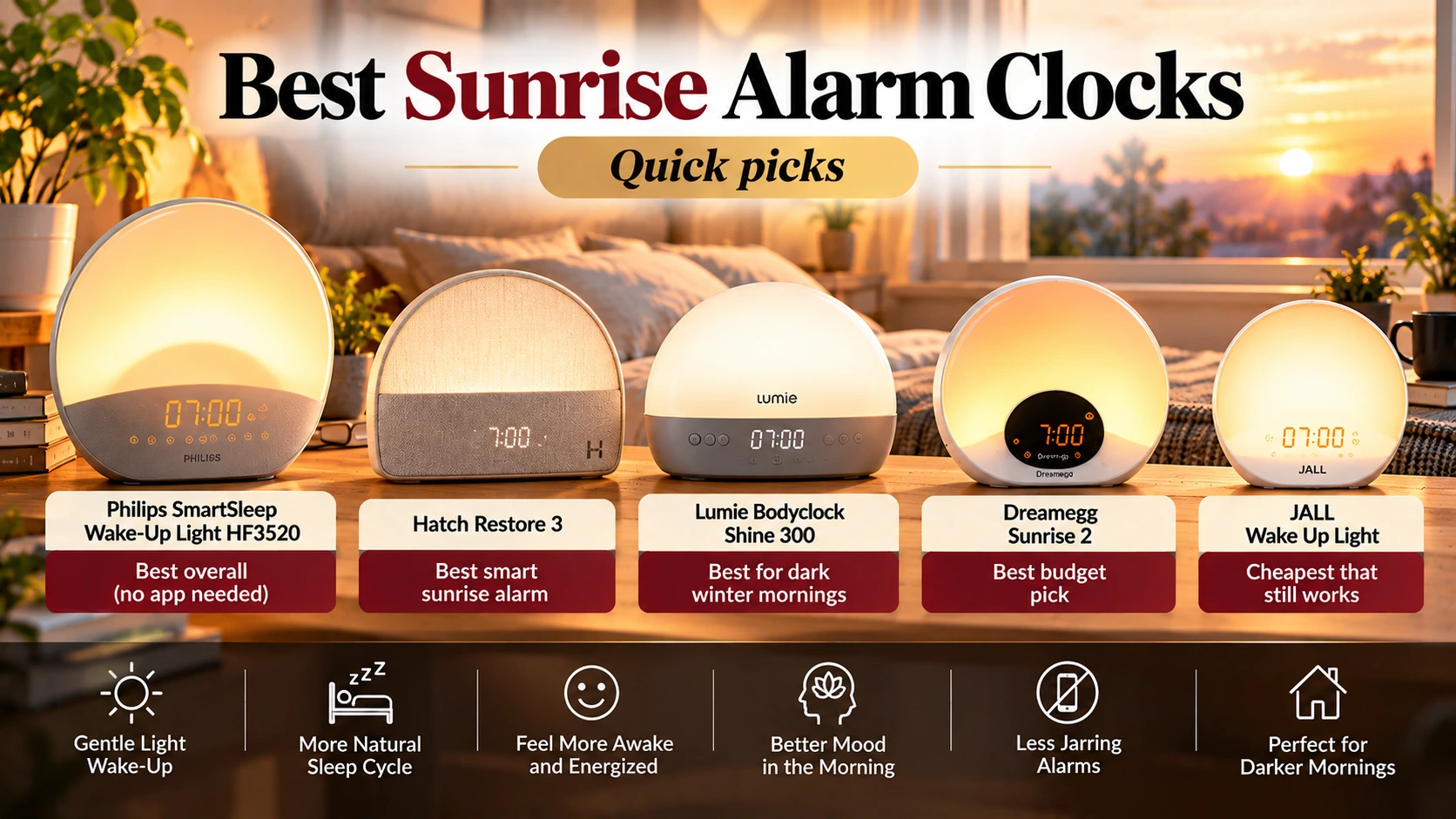
Quick picks
Short on time? These are the five sunrise alarm clocks worth your money in 2026:
- Best overall (no app needed): Philips SmartSleep Wake-Up Light HF3520
- Best smart sunrise alarm: Hatch Restore 3
- Best for dark winter mornings: Lumie Bodyclock Shine 300
- Best budget pick: Dreamegg Sunrise 2
- Cheapest that still works: JALL Wake Up Light
Disclosure: As an Amazon Associate, I earn from qualifying purchases. This costs you nothing extra and helps keep this site running.
Why a sunrise alarm clock?
If your phone alarm jolts you out of sleep and you spend the next 20 minutes in a fog, the problem may not be your willpower. It may be the way you wake up.
That groggy feeling has a name: sleep inertia. A sunrise alarm clock tackles it by brightening your room slowly before your alarm time, the way a real sunrise would. Your body gets a gentle signal that morning is coming, instead of a sudden blast of sound in a dark room.
In this guide, you’ll learn what the research actually says about dawn-simulation lights, which features matter, and which model suits your bedroom and budget. If you’re working on getting up earlier, pair this with our guide on how to wake up early without feeling tired.
How we chose: We have not lab-tested these clocks ourselves. Our picks are based on manufacturer specifications, hands-on reviews from independent testers such as Tom’s Guide, warranty terms, and patterns in verified buyer reviews. We favored clocks that are widely available on Amazon and have a track record of reliability.
Comparison table
| Model | Best for | Max brightness | Sunrise length | App needed? | Warranty | Price tier |
| Philips SmartSleep HF3520 | Most people; no-fuss setup | 300 lux | 20–40 min | No | 2 years | Mid |
| Hatch Restore 3 | Full bedtime and wake routine | Not published | Customizable in app | Yes (setup) | 1 year | Premium |
| Lumie Bodyclock Shine 300 | Dark winters, low mood in winter | Not published | Adjustable | No | 3 years | Premium |
| Dreamegg Sunrise 2 | Best value | Not published | 30–60 min | No | 1 year | Budget |
| JALL Wake Up Light | Lowest cost | Not published | Varies by model | No | Check listing | Budget |
Price tiers: Budget = usually under $50; Mid = $80–$130; Premium = $150 and up. Check the live price on Amazon before buying, because these clocks are often discounted during sales.
Do sunrise alarm clocks actually work? What the science says
Short answer: yes, for most people they make waking up feel easier, though they are not a cure for poor sleep. Here’s what the research shows.
They can reduce morning grogginess. In a 2010 study published in the Journal of Sleep Research, a 30-minute artificial dawn (peaking at 300 lux) before wake time reduced sleep inertia and improved alertness more than switching on the same light at wake time. The same study found no clear effect on cognitive test scores, so the benefit is mainly in how alert you feel. (Van de Werken et al., 2010)
They work at home, not just in labs. A 2010 home study in Chronobiology International tested dawn alarm clocks on people who had trouble waking early. Over two-week periods, both a 250-lux and a gentler 50-lux artificial dawn significantly reduced complaints of grogginess compared with no light. So you don’t need the brightest clock on the market to benefit. (Giménez et al., 2010)
They can lift mood after a short night. In a 2013 lab study in Chronobiology International, 17 adults slept only six hours for two nights. A dawn-simulating light, rising from darkness to 250 lux over the 30 minutes before waking, improved mood and well-being compared with dim light and with a blue light used later in the morning. Cognitive performance also held up better after the first short night. (Gabel et al., 2013)
Timing matters. A newer study published in Building and Environment used motorized curtains to let natural light into a bedroom. Light that arrived about 20 minutes before waking made people less sleepy. Light that arrived at first dawn, long before wake time, disrupted sleep instead. The practical lesson: set your sunrise to start 20–30 minutes before your alarm, not an hour or more. (Wang et al., summarized by PsyPost)
What they won’t do. Most studies are small, run in labs, and use young, healthy adults. A sunrise clock won’t fix insomnia, an irregular schedule, or too little sleep. If you have seasonal low mood or persistent fatigue, talk to a doctor; dawn simulation has been studied for seasonal affective disorder, but it isn’t a substitute for proper care.
One more benefit is practical rather than biological: a dedicated alarm clock means your phone doesn’t have to sleep beside you. That removes the temptation to scroll first thing in the morning, which we cover in how to reduce phone addiction.
How to choose a sunrise alarm clock
Ignore the long feature lists. These six things decide whether a sunrise clock will work for you.
- Adjustable sunrise length. Look for at least 20–30 minutes, and ideally the option to change it. Based on the research above, a 20–30 minute ramp is the sweet spot for most people.
- Enough brightness, with fine control. Brighter isn’t automatically better; even a 50-lux dawn reduced grogginess at home. What matters is being able to dial it up if you’re sleeping through it, or down if your room is small. If a brand publishes a lux figure, 200–300 lux at the bedside is a strong spec.
- A warm color progression. The best models shift from deep red to orange to yellow, like a real sunrise. Cheap models that jump straight to white light feel harsher.
- App or no app. App-based clocks (like Hatch) offer more routines and sounds but need Wi-Fi and a phone for setup. If your goal is less phone use in the bedroom, choose a clock you can run with buttons alone.
- A real backup sound. Light alone doesn’t wake everyone, especially heavy sleepers. Make sure the alarm sound is loud enough and that snooze doesn’t switch the light off completely.
- Sunset mode and a dimmable display. A fading “sunset” helps you wind down, and a display that dims fully means the clock won’t keep you awake.
Watch out for: subscription fees for content, displays that stay bright at night, and no battery backup if you have frequent power cuts.
The 5 best sunrise alarm clocks in 2026
1. Philips SmartSleep Wake-Up Light HF3520: Best overall
Best for: Anyone who wants a proven sunrise light without apps or subscriptions.
Philips has made wake-up lights for years, and the HF3520 is its best-selling model. The sunrise moves from red to orange to bright yellow over a length you choose (20, 30, or 40 minutes) and peaks at 300 lux, with 20 brightness levels so you can fine-tune it. Everything is set with buttons on the clock, so your phone can stay out of the bedroom. Independent testers at Tom’s Guide rate the Philips line as the top phone-free pick for its realistic light.
Key specs: 300 lux max, 20–40 min sunrise, sunset mode, 5 natural wake-up sounds, FM radio, reading lamp, tap snooze, 2 alarms, 2-year warranty.
What we like
- Realistic, warm sunrise that’s well suited to the research-backed 20–30 minute window
- No app, no Wi-Fi, no subscription
- Doubles as a bedside reading lamp
What could be better
- Only 5 wake-up sounds
- Fairly bulky on a small nightstand
2. Hatch Restore 3: Best smart sunrise alarm
Best for: People who want one device for winding down, sleep sounds, and waking up.
The Restore 3 replaced the popular Restore 2 in January 2025 and is Tom’s Guide’s top overall pick. It combines a sunrise light, sound machine, and night light, with a strong speaker. You set it up with the Hatch app over Wi-Fi, but day-to-day controls are now on physical buttons.
A paid Hatch+ membership ($4.99 a month or $49.99 a year, with a 30-day free trial) unlocks extra routines and content. You don’t need it: without a subscription you still get the sunrise alarm, 40-plus sleep sounds, and 20-plus alarm sounds.
Key specs: Sunrise and sunset light, 20 light settings, 40+ sleep sounds and 20+ alarm sounds without subscription, app setup, 1-year warranty.
What we like
- Best sound quality in this list
- Very customizable bedtime and wake routines
- Sleek design that looks good in any bedroom
What could be better
- Needs a phone and Wi-Fi to set up
- The best content sits behind a subscription
3. Lumie Bodyclock Shine 300: Best for dark winter mornings
Best for: Anyone who dreads waking up in the dark from November to February.
Lumie is a UK light-therapy brand, and the Shine 300 is built around a bright, warm sunrise with an adjustable duration. Its LEDs have reduced blue-light content for evening use, and it includes a sunset mode, FM radio, and a fun range of wake-up sounds. It has the longest warranty here, at three years.
Key specs: Adjustable sunrise and sunset, 15 wake-up sounds, FM radio, warm LEDs, 3-year warranty.
What we like
- Bright, warm light that fills a room
- No app required
- 3-year warranty signals confidence in build quality
What could be better
- Premium price
- Light alone may not wake very deep sleepers, so keep a sound alarm on
4. Dreamegg Sunrise 2: Best budget pick
Best for: First-time buyers who want good features without spending much.
The Dreamegg Sunrise 2 is Tom’s Guide’s best budget pick. Its domed face throws light further across the room than the flat first-generation model. Its sunrise and sunset run over 30 to 60 minutes, pick from nine night-light colors, and run everything from buttons on top. It also works as a sound machine.
Key specs: 30 or 60 min sunrise and sunset, 9 light colors, built-in sleep sounds, no app needed, 1-year warranty.
What we like
- Excellent value for the features
- Simple, phone-free controls
- Looks more expensive than it is
What could be better
- Sound quality is only average
- No shorter sunrise option than 30 minutes
5. JALL Wake Up Light: Cheapest that still works
Best for: Trying a sunrise alarm on a tight budget, or for a teen’s room.
JALL’s wake-up light is one of the best-selling sunrise clocks on Amazon. It offers a gradual sunrise, several colors, nature sounds, and FM radio at a low price. The catch is the controls: testers found the many small buttons fiddly to set up.
Key specs: Gradual sunrise, multiple light colors, nature sounds, FM radio. Exact specs vary by model, so check the listing.
What we like
- Lowest price in this guide
- Plenty of features for the money
What could be better
- Fiddly, button-heavy controls
- Independent testers still rank it below the Dreamegg Sunrise 2 for value
For readers in India: Most of these models are sold mainly in the US and UK. Some appear on Amazon.in through importers, often at higher prices. Before you buy, check that the listing ships to India, includes a compatible power adapter, and offers a local warranty.
Which one should you buy?
| If you… | Choose |
| Want the safest all-round choice with no app | Philips SmartSleep HF3520 |
| Want sleep sounds, wind-down routines, and app control | Hatch Restore 3 |
| Struggle most on dark winter mornings | Lumie Bodyclock Shine 300 |
| Want good features on a small budget | Dreamegg Sunrise 2 |
| Just want to try a sunrise alarm cheaply | JALL Wake Up Light |
| Are trying to keep your phone out of the bedroom | Philips, Lumie, or Dreamegg (no app needed) |
| Are a very heavy sleeper | Any of the above, with the sound alarm switched on as a backup |
How to get the most from your sunrise clock
- Set the sunrise to start 20–30 minutes before your alarm.
- Keep it within arm’s reach and angled toward your face, not hidden behind a lamp.
- Use blackout curtains so the clock, not a streetlight, controls your morning light.
- Wake at the same time every day, weekends included. Consistency does more than any gadget.
- Get outside for daylight within an hour of waking. Our guide to the best morning routine explains why.
FAQs
Do sunrise alarm clocks really work?
For most people, yes. Studies show that a gradual artificial dawn before waking reduces grogginess and can improve mood and alertness. They work best alongside a consistent sleep schedule.
Will the light alone wake me up?
Sometimes. Many people wake before the sound, but deep sleepers often don’t. Keep a sound alarm on as a backup, at least for the first few weeks.
How long should the sunrise last?
Around 20–30 minutes suits most people. Research on natural light found that light arriving about 20 minutes before waking worked better than light starting much earlier.
How bright should a sunrise alarm clock be?
The studies above used peaks of 50 to 300 lux, and even 50 lux reduced grogginess at home. Choose a clock with adjustable brightness so you can find your level.
Can a sunrise alarm clock help with seasonal depression (SAD)?
Dawn simulation has been studied for seasonal affective disorder, and some people find it helps on dark mornings. It is not a medical treatment, though. If you have low mood that lasts, speak to a doctor about proper light therapy and other options.
Do I need a subscription?
Only with some smart models. The Hatch Restore 3 works without one, but extra content needs Hatch+. The Philips, Lumie, Dreamegg, and JALL clocks need no subscription.
Are sunrise alarm clocks worth it in summer?
They matter most when it’s dark at wake-up time. In summer, you can still use the sunset mode to wind down and the gentle sounds instead of a harsh phone alarm.
Final verdict
For most people, the Philips SmartSleep Wake-Up Light HF3520 is the best sunrise alarm clock: a realistic, adjustable sunrise with no app or subscription. If you want a complete bedtime-to-morning routine and don’t mind an app, the Hatch Restore 3 is the most capable. On a budget, the Dreamegg Sunrise 2 gives you most of the benefit for much less.
Whichever you choose, set a 20–30 minute sunrise, wake at the same time each day, and let the light, not your phone, start your morning.
Disclosure: As an Amazon Associate, I earn from qualifying purchases. Product details were checked in October 2026 and may change; always confirm specs on the product page.
This article is for general information and is not medical advice.
References
- Gabel V, et al. (2013). Effects of artificial dawn and morning blue light on daytime cognitive performance, well-being, cortisol and melatonin levels. Chronobiology International, 30(8), 988–997. doi:10.3109/07420528.2013.793196
- Van de Werken M, et al. (2010). Effects of artificial dawn on sleep inertia, skin temperature, and the awakening cortisol response. Journal of Sleep Research, 19(3), 425–435. doi:10.1111/j.1365-2869.2010.00828.x
- Giménez MC, et al. (2010). Effects of artificial dawn on subjective ratings of sleep inertia and dim light melatonin onset. Chronobiology International, 27(6), 1219–1241. PubMed
- Wang X, Gu Y, Yuan J, Matsushita D. Natural light control to improve awakening quality. Building and Environment. Summary via PsyPost
- Philips. SmartSleep Wake-up Light HF3520 product specifications. Philips datasheet
- Tom’s Guide. Best sunrise alarm clocks 2026 (updated October 2026). tomsguide.com
- Tom’s Guide. Hatch Restore 3 review. tomsguide.com
- Hatch. Do I need a subscription? hatch.co FAQs