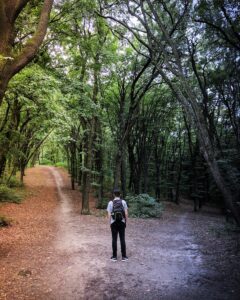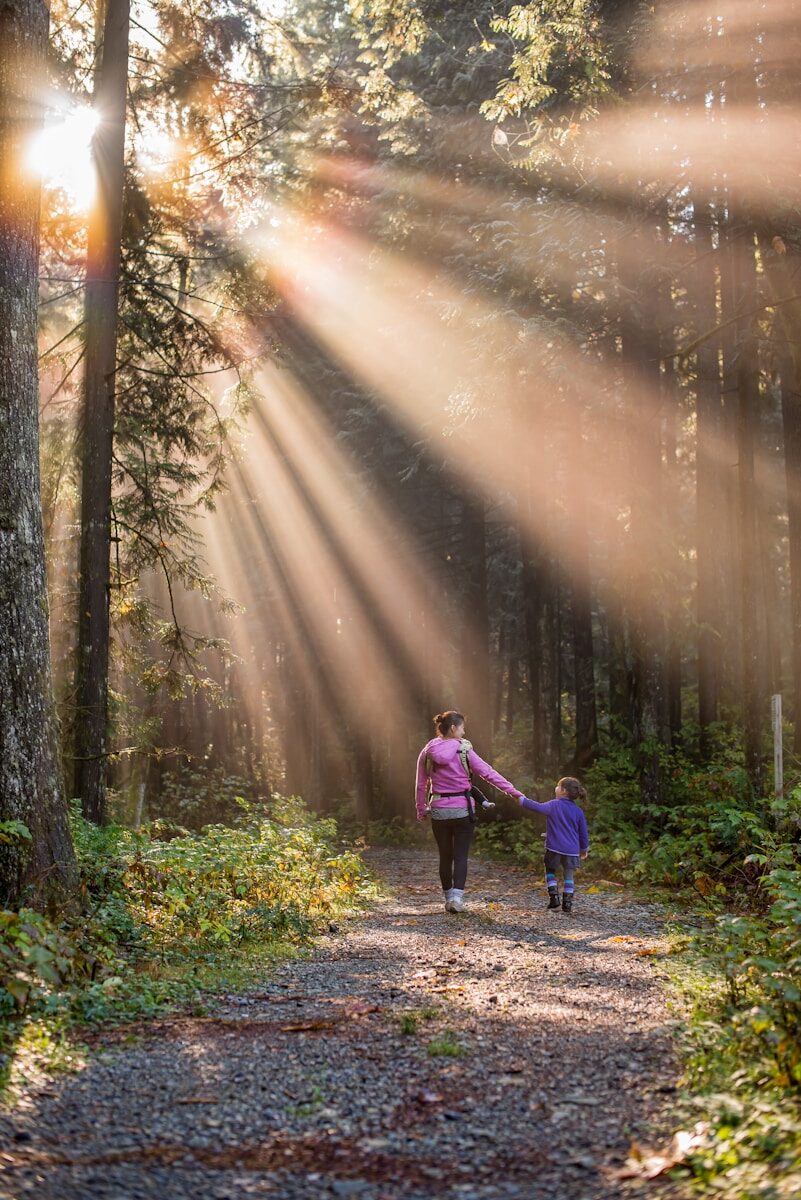
Sunlight & Nature
Your ancestors spent 99% of human history outdoors. They woke with the sunrise. They worked in fields, forests, and open spaces. They spent their days under an open sky. Their bodies and brains evolved in relationship with the natural world — with its light, its rhythms, and its textures.
You are living in the most indoors generation in human history. And the research suggests that your brain still expects the outdoors — still needs it — in ways that are only now being fully understood.
What Nature Does to Your Nervous System
When you step outside into a natural environment — a park, a garden, a forest, a beach — something measurable happens in your body within minutes. Your cortisol levels drop. Your heart rate decreases. Your breathing slows. Your attention shifts from narrow, effortful focus to a softer, more expansive awareness.
Japanese researchers studying the practice of ‘Shinrin-yoku’ — which translates roughly as ‘forest bathing’ — have documented that spending 20 minutes among trees reduces cortisol by 12 to 16%, lowers blood pressure, and decreases heart rate, compared to spending the same time in an urban environment.
Environmental psychologists Rachel and Stephen Kaplan developed a theory called Attention Restoration Theory, which proposes that natural environments restore our capacity for directed attention — the kind of focus we use for work, problem-solving, and decision-making. After spending time in nature, people perform better on concentration tasks. The brain, it seems, uses the natural world to recharge.
Science says: A 2019 study in the journal Scientific Reports found that spending at least 120 minutes per week in nature was associated with significantly better health and wellbeing. Even if this time was spread across several short visits, the effect held.
Sunlight and Your Internal Clock
Natural light is not merely pleasant. It is biologically necessary.
Your retinas contain specialised photoreceptors — separate from those used for vision — that detect light levels and transmit this information directly to the area of your brain that governs your circadian rhythm: the suprachiasmatic nucleus.
When morning sunlight enters your eyes (you do not need to look directly at the sun), it triggers a cascade of biological events. Cortisol rises appropriately, helping you feel alert. Serotonin — the neurotransmitter most associated with mood stability, calmness, and wellbeing — begins to be produced. And a timer is set that will govern when melatonin (the sleep hormone) is released 12 to 16 hours later.
Getting natural light within an hour of waking is one of the most powerful and underrated health habits available to you. It takes no special equipment, no money, and only a few minutes. Just step outside.
The Experience of Awe
There is a particular emotional experience that natural environments uniquely provide: awe. The feeling of being in the presence of something vast, beautiful, or beyond your full comprehension — a mountain, an ocean, a starry sky, a towering forest.
Research by psychologist Dacher Keltner at UC Berkeley has found that awe is associated with a reduction in self-focused thinking, an increase in prosocial behaviour, and a significant positive shift in mood. People who regularly experience awe are also more likely to feel that their lives have meaning.
Awe reminds you, gently, that you are a small part of something much larger. That perspective can be profoundly grounding.
Nature in Cities and Small Spaces
You do not need to live near mountains or forests to benefit from nature. Research shows that even small encounters with the natural world — a park bench, a window view of trees, a potted plant on a desk — produce measurable positive effects.
Studies at the Royal Horticultural Society and other institutions have shown that even a single plant in a workspace improves reported mood and focus. Looking at images of nature, while less effective than the real thing, still produces some of the same calming effects.
Urban parks matter enormously. If you have access to any green space — however small — using it regularly is one of the highest-return wellbeing habits available to you.
For Those in Difficult Climates or Environments
For people living in cold climates, northern latitudes, or cities with limited green space, the barriers to natural light and nature are real. A few adaptations:
Light therapy lamps — which mimic the spectrum of natural sunlight — have strong evidence for improving mood, particularly in winter and for people with seasonal affective disorder. Even 20 to 30 minutes of light therapy in the morning can make a meaningful difference.
Indoor plants are more than decoration. Tending to something living — even a small succulent — provides a daily micro-interaction with the natural world.
Water is also a natural environment. Rivers, lakes, the sea, even a fountain in a public square — ‘blue spaces’ show similar benefits to green ones.
YOUR ACTION STEPS
- Morning light within one hour of waking: Step outside — or sit by an open window — for 10 minutes after waking. No sunglasses for the first few minutes. This one habit can improve mood, energy, and sleep quality simultaneously.
- The park lunch: At least three times this week, take your lunch break outside in a green space. Walk, sit, or simply be. Leave your phone in your pocket.
- Add one plant: One plant in your home or workspace. Water it. Notice it. Research shows even this small connection to something living improves reported wellbeing.
- Barefoot on earth: Stand on grass, soil, or sand with bare feet for five minutes. The practice — sometimes called ‘grounding’ — has early evidence for reducing inflammation and improving calm. At minimum, it is a simple way to be present in your body and the natural world.
- Nature sounds at home: If you cannot get outside, play birdsong or rain sounds. It is not the same as being there, but it is closer than silence or a screen.
Try this before the day ends: Go outside. Even for five minutes. Look up at the sky. Notice what you see.